
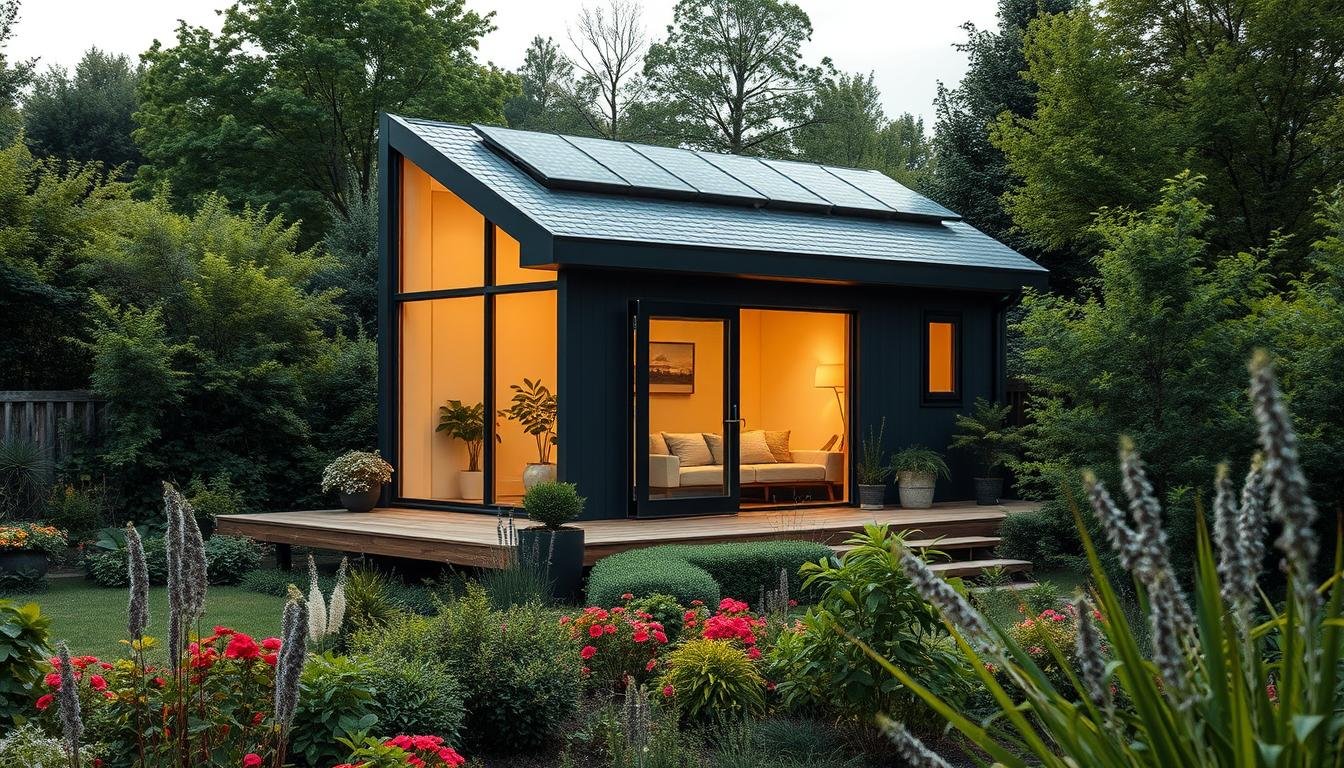
Zero-Energy Tiny House began as a student-led effort at Western Washington University and proved a compact project could match its annual energy use with on-site production.
The team integrated a 5 kW solar array paired with Enphase microinverters and a Tesla Powerwall. They used Structural Insulated Panels (SIPs) and high-performance Innotech windows to cut loads before adding storage.
The case study showed how thoughtful design reduced demand so renewable systems stayed right-sized. It highlighted life-cycle-conscious materials, on-site water storage, and metering with Egauge for real-time monitoring.
Readers will follow the full path from early concept and material selection to permitting, site choice, and construction sequencing. The guide clarifies where construction efficiency matters most and how a coordinated team and company choices speed delivery and improve results.
Key Takeaways
- Real Project Model: A campus build demonstrated feasible net-energy goals for a compact home.
- Envelope-First Approach: SIPs and high-spec glazing cut loads before adding renewables.
- Right-Sized Systems: Energy modeling and monitoring kept equipment efficient.
- Multidisciplinary Team: Planning, permitting, and procurement streamlined construction.
- Site And Metering: Solar access, storage, and Egauge data validated performance.
Zero-Energy Tiny House Overview And Why It Matters
Net annual balance means a home produces as much energy on-site as it consumes over a year. Compact footprints make this easier because smaller homes use less power. That lowers both equipment cost and the complexity of systems sizing.
Off-grid living reduces bills and carbon emissions. It also improves resilience during outages and enables flexible siting away from utility lines. Self-reliance depends on good storage planning and backup strategies for low-energy days.
The distinction between tiny homes and other small houses matters in design. Smaller dwellings drive lower baseline loads, so panels and batteries can be right-sized rather than oversized. This simplifies installation and maintenance.
- Lifestyle Benefits: Less maintenance, mindful consumption, and financial predictability.
- Community Benefits: Lower grid demand, lower emissions, and scalable project models.
- Design Focus: Envelope performance and ventilation deliver comfort without oversized systems.
| Focus Area | Why It Matters | Practical Tip | Outcome |
|---|---|---|---|
| Envelope | Reduces heating and cooling loads | Use high R-value panels and tight sealing | Smaller systems, better comfort |
| Renewables | On-site generation balances annual use | Right-size array for predictable loads | Lower costs, simpler maintenance |
| Storage & Backup | Handles variability and low-sun periods | Plan capacity for seasonal needs | Resilience during outages |
| Behavior & Monitoring | Occupant patterns affect performance | Install metering and set targets | Predictable energy balance |
This overview sets expectations for later chapters on targets, permitting, passive design, systems selection, and commissioning. Early planning keeps performance goals central, avoiding surprises from seasonal weather or shifting occupant behavior.
Understanding Net-Zero Energy Goals For Tiny Homes
A practical net-zero strategy ties modeled loads to realistic generation and storage plans. It defines success as a 12-month balance between a home’s total consumption and on-site generation rather than simply disconnecting from the grid.
Defining Net-Zero Energy Versus Off-Grid
Net-zero energy means annual parity: total kWh produced on site equals kWh consumed over 12 months. Off-grid status, by contrast, refers to utility independence in real time and not necessarily to yearly balance.
“Annual accounting—not momentary supply—determines net-zero performance.”
Setting Performance Targets For Annual Energy Balance
Start with modeled loads and local weather data to set an annual kWh target. Translate that into array size, inverter capacity, and battery storage using hourly profiles so power matches living patterns without unnecessary oversizing.
Choose high-R-value building materials and tighten the envelope to cut heating and cooling loads. Lower demand reduces required array area and battery capacity, so material choices directly affect system cost and footprint.
- Use company calculators to convert appliance lists and run-times into daily and seasonal consumption estimates.
- Define comfort and IAQ levels to set ventilation rates and recovery efficiency that meet health needs while keeping energy realistic.
- Document assumptions in the Basis of Design and include safety factors, commissioning checks, and intermediate milestones like leakage goals and PV yield.
Benefits Of A Zero-Energy Tiny Home
A compact, well-sealed dwelling slashes monthly utility bills while improving comfort and resilience.
Quantified Cost Savings: Lower annual loads reduce bill volatility and demand charges. Paired with a right-sized solar array and battery, the typical small home can cut utility bills by 60%–90%, shortening payback for PV and storage when incentives are applied.
Carbon And Climate Advantages: On-site renewables displace grid electricity, lowering lifecycle emissions compared with larger homes. That reduction supports community climate goals and reduces dependence on fossil-fired generation.
- Resilience: Energy storage and efficient systems keep essentials running through outages.
- Lower Maintenance: Smaller spaces mean fewer systems to maintain and lower long-term ownership costs.
- Comfort & Health: Tight envelopes and balanced ventilation deliver stable temperatures and cleaner air.
Realistic Returns: Payback timelines for PV plus batteries often fall within 7–15 years depending on incentives, avoided infrastructure costs, and reduced operating expense.
“Autonomy, simplicity, and intentional living are frequently cited as the most meaningful outcomes.”
These benefits compound over time: durable assemblies, efficient appliances, and careful system choices increase the margin by which a tiny house meets annual energy targets and raises occupant satisfaction.
Planning Your Site, Zoning, And Permits In The United States
A careful site evaluation ensures sunlight, drainage, and code constraints match the project’s goals.

Siting For Solar Access, Climate, And Utilities
Evaluate sun path and shading with simple tools or a professional analysis. Seasonally consistent exposure limits panel loss and improves annual yield.
Review microclimate, wind, snow loads, and flood maps. Those factors affect mounting, anchoring, and the longevity of the building and systems.
Plan for utility hookups or on-site systems. ZeNETH used interim electrical connections and an on-site water tank to keep construction moving while permits were pending.
Navigating Local Codes, HUD, IRC, And Tiny House Regulations
Jurisdictions treat small dwellings differently. Verify whether the site falls under accessory dwelling, RV, manufactured home, or IRC paths.
Factory-built units often come with company claims of HUD, IRC, or IBC compliance, but the team must confirm local acceptance before purchase.
Typical permit sets include site plan, foundation or chassis anchoring, electrical/solar, and plumbing. Coordinate early with the utility for interconnection and NEC-required documentation.
| Permit Type | When Needed | Who Prepares | Key Documents |
|---|---|---|---|
| Site Plan | All builds | Design Team | Plot map, grading, setbacks |
| Foundation / Chassis | On-site or trailer | Structural Engineer | Anchoring details, footing plans |
| Electrical / Solar | Grid-tied or inverter | Licensed Electrician | Single-line diagram, interconnection form |
| Plumbing / Water | On-site storage or hookups | Plumber | Fixture counts, tank sizing, filtration |
Practical Tip: Use phased approvals to align construction milestones with inspections and reduce rework. Assign clear roles for permitting, neighbor communication, and inspection scheduling to keep the project on track.
“Early coordination with code officials and the utility avoids costly changes during construction.”
Choosing Size, Square Feet, And Tiny Home Floor Plans
Choosing the right footprint starts with mapping daily routines against usable square feet. This helps match livability goals to energy and storage needs.
Space Planning For 120-400 Square Feet
Designers commonly plan between 120 and 400 square feet. Project ZeNETH targeted about 250 square feet, showing how a compact tiny home can include a kitchen, bath, and mechanical closet without feeling cramped.
Multi-Use Zones And Storage Solutions
Map convertible zones for sleeping, working, and dining. Use sliding partitions and furniture that folds or stacks to free up space during the day.
- Toe-kick drawers and built-in seating preserve sightlines.
- Ceiling-hung cabinets and exterior lockers boost storage without expanding footprint.
- Choose compact appliances to simplify service chases and maintenance.
| Layout Type | Trade-Off | Best Use |
|---|---|---|
| Loft / Vertical | Stairs, headroom limits | Smaller footprint, more floor space |
| Single-Level | Requires wider plan | Accessibility, simpler HVAC |
| Modular Add-On | Higher initial planning | Future expansion without more conditioned area |
Ergonomics matter: specify door swings, clearances, and appliance service access. Compact size reduces envelope area and heat loss, helping meet energy targets. Document dimensioned floor plans and elevations to speed approvals and fabrication.
“A well-documented plan turns tight square-foot limits into thoughtful, resilient living.”
Design And Orientation For Passive Energy Savings
Orient the living spaces and glazing to harvest low winter sun while blocking high summer rays for passive comfort. Simple layout moves can cut heating and cooling loads before any active system is sized.

Solar Orientation And Shading Strategies
Place primary glazing to capture low-angle winter sun and minimize shading near the panels for peak yield. In some regions the array faces north for optimal tilt; in others minimal obstruction matters most.
Use overhangs, deciduous trees, or exterior blinds to reduce summer gains while keeping daylight and views. For detailed siting advice see optimal building orientation.
Thermal Zoning, Daylighting, And Natural Ventilation
Concentrate high-gain activities in a warm core and buffer edges with storage or service zones. Guide airflow with door placement and short paths to encourage cross-ventilation.
Operable windows, skylights, and vents enable stack effect cooling. These features maintain IAQ and control moisture without heavy mechanical ventilation.
Window-To-Wall Ratios For Comfort And Efficiency
Balance window area with U-values and SHGC to manage heat loss and glare. Fixed glazing suits daylighting; operable windows provide ventilation where needed.
| Strategy | Design Action | Expected Outcome |
|---|---|---|
| Orientation | Align long axis to sun angles | Lower seasonal heating demand |
| Shading | Overhangs & operable screens | Reduced summer cooling |
| Zoning | Core heat, buffer edges | Stable interior temperatures |
| Materials | Thermal mass and light roof | Smoother daily swings |
“Passive design shrinks active system needs, allowing smaller arrays, batteries, and simpler controls.”
Building Envelope: Structural Insulated Panels, Windows, And Air Sealing
Choosing assembly-driven wall systems can shorten schedules while improving thermal performance. Project ZeNETH used structural insulated panels to speed enclosure work and lift the home’s energy performance.
Why Structural Insulated Panels Improve Energy And Build Time
Structural insulated panels combine structure and rigid insulation into one factory-made element. That reduces thermal bridging, lowers on-site cutting, and shortens labor hours.
Selecting High-Performance Windows And Doors
Pick tested frames, low-e glazing, and proper U- and SHGC ratings for the climate. The ZeNETH project paired SIPs with Innotech windows to ensure airtight seals and long-term performance.
Continuous Air Barrier, Insulation Levels, And Moisture Control
Panel joints, splines, tapes, and gaskets form a continuous air barrier when detailed correctly. Combine that with climate-appropriate panel thickness and a rainscreen to manage vapor and bulk moisture.
Durability In Hot, Cold, And Coastal Climates
Specify corrosion-resistant fasteners, UV-stable finishes, and capillary breaks for coastal exposure. These material choices extend service life and protect building materials across climates.
| Assembly Feature | Action | Expected Outcome |
|---|---|---|
| SIP Panels | Factory-cut joints, splines | Faster enclosure, less thermal bridging |
| Window Selection | Frame, glass, and testing | Stable comfort, lower heat loss |
| Air Barrier | Tape, gaskets, blower-door verify | Low infiltration, predictable energy |
“Blower-door testing before finishes finds leaks when fixes are easy.”
Renewable Power Systems: Solar Array, Batteries, And Inverters
Good renewable system design begins by matching real use patterns to hourly sun data and battery throughput. This step converts appliance runtimes into the solar array capacity and usable storage needed to meet year-round energy goals.

Sizing A Solar Array And Solar Panels For Year-Round Loads
Start with a load worksheet and local weather data to model hourly needs. Translate daily kWh into array kW, then validate output for winter months and cloudy stretches.
Choose panels by efficiency, form factor, and warranty. Lay out modules to reduce shading and fit compact roof geometries while keeping tilt and azimuth optimized for winter production.
Battery Storage Options From Powerwalls To Modular Kits
Compare integrated options like the Tesla Powerwall to modular kits such as EcoFlow Power Kits. Consider usable capacity, cycle life, and how the battery integrates with inverters.
For off-grid or hybrid systems the EcoFlow calculator helps size loads and storage. Project ZeNETH used a 5 kW array with Enphase microinverters and a Powerwall to illustrate resilience.
Microinverters Versus String Inverters For Resilience
Microinverters provide panel-level optimization and fault isolation, which helps when shading or partial failures occur. String inverters can be more cost-effective for uniform arrays but offer less granular control.
Backup And Low-Energy Day Strategies
Plan charge controllers and choose DC-coupled or AC-coupled architecture based on storage goals. Coordinate with a generator for extended outages and implement load-shedding or smart controls for low-energy days.
| Topic | Key Consideration | Practical Action |
|---|---|---|
| Array Sizing | Hourly yield vs demand | Model with local PVWatts or similar |
| Panel Selection | Efficiency, warranty, form | Prioritize high-efficiency on small roofs |
| Storage | Usable kWh and cycles | Compare Powerwall and modular kits |
| Inverter Choice | Resilience vs cost | Use microinverters for shading-prone arrays |
| Code & Safety | NEC disconnects, labeling | Install rapid-shutdown and documented diagrams |
Practical Tip: Reserve extra inverter capacity or conduit for future expansion. For modular off-grid guidance and sizing tools see Solar Power for Small Dwellings.
Water Supply, Filtration, And Waste Solutions
Reliable water planning starts with mapping annual rainfall, daily use, and storage placement for the site. This short assessment shapes source choice, tank sizing, and energy needs for pumps and treatment.
Rainwater Harvesting, Wells, And On-Site Storage Tanks
Collect roof runoff or tap a well based on local yields and permits. Size tanks from daily demand and seasonal patterns so reserves cover dry periods.
Practical points: place storage where the building can bear weight and add freeze protection in cold climates.
Filtration For Potable Water And Greywater Reuse
Use multi-stage filtration for drinking water: sediment, carbon, and UV or chlorination for disinfection. Schedule cartridge and UV lamp changes to protect supply.
For greywater, employ simple mechanical filters and subsurface drip or constructed wetlands where codes allow. These systems cut freshwater demand and lower septic loads.
Composting Toilets And Autonomous Waste Systems
Composting toilets reduce flush volume and simplify wastewater treatment. Compare units by capacity, ventilation, and service intervals to match household size.
Benefits: lower infrastructure cost, reduced environmental impact, and more autonomy during outages. Include pump and treatment power in the energy budget.
“Monitor tanks and filters with sensors and logs to prompt maintenance before performance drops.”
- Short, insulated distribution lines reduce heat loss and freezing risk.
- Plan drought contingencies and winterization steps for year-round reliability.
- Document service schedules and install level switches for remote alerts.
High-Efficiency Systems, Appliances, And Indoor Air Quality
A blend of compact, efficient equipment and simple controls helps small homes meet comfort and energy goals. This approach reduces peak power needs and lets renewable systems be smaller and less costly.

Right sizing begins with accurate load worksheets and a plug-load audit. That informs HVAC capacity, inverter choice, and breaker sizing so nameplate totals match available supply.
Right-Sizing HVAC, Ventilation, And Heat Recovery
Choose heat pumps with low turndown ratios or ductless mini-splits for small volumes. These units preserve comfort without short-cycling, which wastes energy and wears equipment.
Balanced ventilation with an HRV or ERV maintains IAQ and controls moisture. Add HEPA filtration where occupants are sensitive to allergens or when manufactured offerings include it.
Efficient Cooking, Refrigeration, And Smart Controls
Prefer induction cooktops and high-efficiency refrigeration to cut continuous loads. Heat pump water heaters deliver large savings compared with resistive tanks.
Smart controls coordinate setpoints, occupancy sensing, and timed charging to shave peaks. They let the living space stay comfortable while the system limits battery cycling.
Moisture and Passive Strategies: Operable windows, shading, and sensible ventilation preserve comfort and reduce the burden on mechanical systems. Demand-controlled fans in baths and kitchens capture moisture at the source.
“Quiet, well-isolated equipment improves acoustic comfort and reduces perceived crowding in compact living areas.”
| Topic | Recommendation | Benefit |
|---|---|---|
| HVAC | Heat pump mini-split with low turndown | Reduced cycling, better COP at low loads |
| Ventilation | HRV/ERV with HEPA option | Stable IAQ and moisture control |
| Appliances | Induction, heat pump water heater, efficient fridge | Lower continuous draw, less storage demand |
| Controls | Occupancy sensors, scheduled charging | Peak shaving, longer battery life |
Maintenance: Clean filters, clear condensate drains, and update firmware on smart devices. A simple checklist preserves performance and prevents moisture problems in compact space.
For integrated examples of energy and IAQ systems used in compact living, see the eco-friendly systems page for detailed equipment summaries and sizing tips.
Materials Selection: Low-Toxic, Durable, And Life-Cycle Conscious
Material choices set the tone for occupant health, longevity, and lifecycle costs in compact building projects. Project ZeNETH prioritized life-cycle-conscious products and tested assemblies to reduce replacement cycles and embodied impacts.
Evaluating Building Materials For Health And Sustainability
Start by screening for VOCs, formaldehyde, and third-party certifications such as GREENGUARD or Cradle to Cradle. Low-toxicity selections protect indoor air and simplify commissioning goals in a small home.
Compare durability metrics—rot resistance, corrosion rating, and UV stability—so finishes last in each climate. Choose high-abrasion flooring, washable paints, and laminate cabinets where wear concentrates.
Life-cycle assessments help a company or owner weigh embodied carbon against expected service life. Favor materials with recycled content, salvage options, or rapid renewability to cut footprint without sacrificing performance.
- Compatibility: Match permeance and fastening systems to preserve airtightness and moisture control.
- Supply & Warranty: Prefer manufacturers with clear technical data, test reports, and support for retrofit or repair.
- Finish Strategy: Use light-reflective surfaces to boost daylighting and make compact interiors feel larger.
Practical tip: Consider factory-integrated systems like those from haus.me when a full package reduces field work and brings documented filtration (HEPA) and assembly performance.
“Selecting durable, low-emission materials reduces waste, speeds installation, and improves long-term comfort.”
For a practical list of sustainable options and reuse strategies, see this guide on sustainable building materials for small builds: sustainable material choices.
Cost, Budgeting, And Long-Term Cost Savings
Estimating lifetime costs up front prevents surprises and frames trade-offs between prefab options and custom builds. This budget-first view guides design choices, procurement, and financing so the project stays on schedule and on cost.
Estimating Design, Construction, And Systems Costs
Break the budget into soft costs (design, permits, inspections), trade-level construction, and systems: PV, storage, HVAC, and water. Include allowances for specialized lead times and a contingency of 10%–15%.
Compare manufacturer list prices—e.g., prefab options from haus.me show starter ranges ($35,000 for ~120 ft²; $160,000 for ~400 ft²; $299,000 for ~800 ft²)—against itemized custom bids to assess value and schedule impact.
Operating Savings From Net-Zero Energy And Off-Grid Living
Upfront system costs often yield measurable cost savings in utility bills and avoided fuel purchases. Model 10–20 year ownership scenarios that include energy price escalation and routine maintenance.
- Use sensitivity analysis to test energy price and maintenance risks.
- Explore financing, grants, and tax incentives to lower capital need.
- Track costs by category to create open benchmarks for future home builds and resale valuation.
“Commissioning and monitoring protect the investment by verifying system performance.”
Project Management, Team, And Build Timeline
Defined accountability and routine check-ins turned academic planning into reliable field progress. The core team assigned roles for owner, designer, engineer, and trades so communication paths stayed clear.
Work moved in phases: design, procurement, construction, commissioning, and closeout. Each phase included float to absorb delays and protect the schedule.
Practical tools kept the build on track: Gantt charts, weekly stand-ups, and an RFI log. Long-lead items were sequenced to arrive before critical-path tasks to avoid lost time on site.
- Site safety plans, inspection schedules, and documentation streamlined approvals.
- Change management protocols limited scope creep and preserved budget.
- Milestones: envelope dry-in, pre-drywall checks, and commissioning readiness checks.
“Early milestones and clear handover documentation make operations and warranty claims straightforward.”
The student-led project drew specific lessons about stakeholder coordination and the value of shared schedules. These practices improved construction experience and eased handover to the owner at completion.
Case Study: Project ZeNETH Zero-Net-Energy Tiny House
Project ZeNETH at Western Washington University served as a compact demonstration of integrated design, materials, and monitoring. The team built a ~250 sq ft living module sited on campus to test performance, permitting, and community engagement. The build emphasized life-cycle-conscious materials and open-source documentation so other teams could replicate the approach.
5 kW Solar Array, Enphase Microinverters, And Tesla Powerwall
The project deployed a 5 kW solar array with Enphase microinverters to improve panel-level output and fault isolation. A Tesla Powerwall provided usable storage to support critical loads and ride through low-sun periods.
Performance focus: array layout minimized shading and prioritized winter yield, while storage sizing targeted predictable resilience rather than full off-grid autonomy.
Using SIPs And High-Performance Innotech Windows
SIPs and German-engineered Innotech windows sped enclosure work and produced a tight thermal envelope. The structural insulated panels reduced thermal bridging and shortened on-site labor.
Floor plans fit a compact kitchen, bathroom, and service chase to keep mechanical runs short and thermal zones clear. These choices lowered heating loads and simplified commissioning.
Egauge Monitoring For Data-Driven Performance
Egauge metering in the electrical panel delivered circuit-level, real-time data to validate models and guide optimizations. Public display of the data supported outreach and research objectives.
Permit coordination with campus facilities and stakeholder engagement smoothed inspections and the temporary electrical hookup. The team documented commissioning steps and early targets to confirm the net-zero energy trajectory.
“Open documentation and measured results let the ZeNETH team share specs, lessons, and a scalable template for similar projects.”
| Topic | Design Action | Outcome |
|---|---|---|
| Size | ~250 sq ft footprint | Balanced comfort and energy goals |
| Renewables | 5 kW array + microinverters | Improved panel-level performance |
| Envelope | SIPs + Innotech windows | Tighter envelope, faster build |
| Monitoring | Egauge circuit data | Validated assumptions, public display |
For detailed project documentation and design resources see the full project page at Project ZeNETH.
Prefab And Manufactured Options: Comparing Autonomous Tiny Houses
Factory-built, fully outfitted units arrive ready to connect, shrinking on-site work and fast-tracking occupancy. Buyers weighing prefab solutions should compare systems, transport logistics, warranties, and the real delivered scope of finishes.
Factory-Finished Units, Rapid Install, And Code Compliance
Some companies, like haus.me, deliver models from 120 ft² to 800 ft² that claim HUD/IRC/IBC compliance and same-day install on a transportable chassis.
Verify compliance with local authorities before purchase. Request stamped documents and factory test reports to confirm that the unit meets jurisdictional rules.
Off-Grid Features: Solar, Air-To-Water Generation, And HEPA Filtration
Factory options often include integrated solar power, battery packs up to 100 kWh, and autonomous waste or tank systems for living off-grid with minimal setup.
Air-to-water generation adds water redundancy in humid climates. Advanced HEPA IAQ packages improve filtration for occupants with sensitivities.
Comparing Value, Transport, And Service
Consider: included furniture, smart controls, warranty length, and after-sales support. Transport logistics, minimal foundation needs, and anchoring choices affect total site prep cost.
| Topic | What To Check | Typical Benefit | When It’s Best |
|---|---|---|---|
| Systems Included | Solar, battery, HVAC, IAQ | Turn-key install, tested integration | Tight timelines, remote sites |
| Code & Paperwork | HUD/IRC/IBC documents, local sign-off | Faster permitting if verified | Urban lots, resale markets |
| Site Needs | Chassis, anchors, minimal foundation | Lower civil work, same-day set | Sites with poor local trades |
| Warranty & Support | Factory service, parts, remote diagnostics | Lower lifecycle risk | Owners seeking packaged solutions |
“Prefab autonomous units deliver speed and predictability, but buyers must verify claims and confirm local acceptance.”
Step-By-Step Build: From Foundation To Commissioning
Leveling the plot, creating a clear access route, and choosing a trailer or chassis rated for the expected load prepares the site for fast, safe work.
Floor framing follows with moisture and thermal breaks at the chassis interface. Project ZeNETH completed floor framing early and routed electrical and plumbing through the service chase to keep runs short.
Site Prep, Trailer Or Chassis, And Floor Framing
Select a chassis rated for gross vehicle weight and verify axle spacing for transport. Install blocking, vapor barrier, and a thermal break between steel and the subfloor.
Envelope Assembly With Structural Insulated Panels
Lay out insulated panels for minimal cuts, follow the fastening schedule, set spline details, and apply continuous sealant at joints. Weatherproof with taped seams and a rainscreen before windows are installed.
Rough-Ins: Electrical, Plumbing, And Mechanical Systems
Sequence rough-ins to match inverter and panel specs and to minimize conduit runs. Keep plumbing layouts compact and group services to reduce heat loss and complexity.
Interior Finishes, Fixtures, And Final Air Sealing
Use lightweight paneling, resilient flooring, and compact fixtures to control weight and durability. Complete final air sealing with tapes, gaskets, and a blower-door test before trim closes cavities.
- Materials handling: stage panels and mechanicals near the work face to save time.
- Sequencing: dry in the envelope before finishes to protect assemblies.
- Quality checks: inspect fastening, penetrations, and clearances at each milestone.
| Check | Responsible Trade | Typical Time |
|---|---|---|
| Floor Framing & Thermal Break | Carpenter | 1–3 days |
| SIP Layout & Sealing | Envelope Crew | 2–4 days |
| Rough-Ins (Elec/Plumb/Mech) | Electrician/Plumber | 2–5 days |
| Blower-Door & Final Sealing | Commissioning | 1 day |
Pre-commissioning closes with labels, as-built diagrams, safety devices, and a checklist so systems start cleanly and inspections streamline commissioning. For guidance on mobile foundations and chassis selection see the mobile foundations guide.
Commissioning, Monitoring, And Optimizing Performance
System startup and handover begin with clear documentation and labeled circuits so technicians and occupants know what each breaker, disconnect, and control does.
Technicians verify safety devices: GFCI and AFCI operation, meter wiring, inverter grounding, and smoke/CO alarms. They also run ventilation airflow checks and perform leak testing on water and envelope penetrations.
System Startup, Safety Checks, And Energy Baselines
Establish an energy baseline by logging steady-state loads for several days: fridge, HVAC, charging, and standby draws. Compare those logs to the modeled energy to spot gaps.
Practical items: label panels, verify rapid-shutdown, confirm ventilation CFM, and record initial thermostat setpoints and runtimes.
Monitoring With Smart Meters And Data Platforms
Configure smart meters, Egauge, and inverter portals to capture generation and consumption at 1–15 minute intervals. Project ZeNETH used Egauge plus microinverter data to show panel-level yield and circuit-level use in a ~250 sq ft home.
KPIs include envelope leakage (ACH50), HVAC runtime hours, standby watts, and daily solar yield versus prediction. Use dashboards and alerts to flag anomalies and schedule maintenance.
| Area | What To Measure | Action | Outcome |
|---|---|---|---|
| Electrical | Panel circuits, inverter output | Install smart metering and label breakers | Faster troubleshooting |
| Envelope | ACH50, thermal leaks | Retest after sealing | Lower heating/cooling runtime |
| Systems Controls | Schedules, charge windows | Adjust to reduce peaks | Better self-consumption |
| Operations | Dashboards, alerts | Set thresholds and maintenance reminders | Higher reliability over time |
A post-occupancy evaluation captures comfort, acoustics, usability, and unexpected loads. Seasonal tuning—ventilation rates, shading positions, and setpoints—keeps performance steady across weather.
Teams should anonymize and share datasets to refine best practices for living off-grid and community-scale renewable energy projects. For guidance on ongoing recommissioning see building recommissioning.
Conclusion
A focused design process can turn modest square footage into a resilient, efficient home that performs year-round.
Compact design, robust envelopes, and right-sized systems enable comfort and reliability while keeping energy demands low. These choices let homes meet annual targets without oversized equipment.
The long-term benefits compound: cost stability, greater resilience, and lower environmental impact. That outcome improves living quality and reduces operating risk over time.
Prefab options and a well-coordinated team expand pathways to success. Models such as a tiny house and tiny houses from manufacturers offer tested assemblies and faster delivery for many budgets.
Real-world experience, open data (Egauge outputs), and shared case studies speed learning and optimization. Owners should verify local codes, tune systems seasonally, and keep monitoring in place.
Call to action: Start with a realistic scope, assemble the right team, and build an efficient, resilient home that matches your goals and local rules.
FAQ
What defines a net-zero energy tiny home and how does it differ from an off-grid dwelling?
A net-zero energy dwelling produces as much energy annually as it consumes, typically by combining high-efficiency design with a renewable generation system such as a solar array. It usually stays connected to the grid for backup or export. An off-grid home operates independently from utility services, relying on on-site generation, battery storage, and sometimes backup generators. Net-zero focuses on annual energy balance; off-grid focuses on full utility independence.
How big should the living space be to balance comfort and energy efficiency?
Most designs balance function and efficiency within 120–400 square feet. Smaller footprints reduce heating, cooling, and lighting loads, but layout and multi-use zones must be optimized for storage and comfort. Proper space planning and efficient appliances further reduce required energy capacity.
What are the fastest ways to reduce energy demand during design?
Prioritize building orientation for solar access, high-performance insulation such as structural insulated panels (SIPs), tight air sealing, right-sized windows, and passive strategies like daylighting and natural ventilation. These choices shrink HVAC and generation needs, lowering system cost and complexity.
Are structural insulated panels a good choice for this type of build?
Yes. SIPs accelerate assembly, improve thermal performance, and reduce air leakage compared with traditional framing. They provide consistent insulation levels and can decrease build time. Choose panels with durable facings and verify moisture control details for the climate.
How does one size a solar array and battery bank for year-round performance?
Start with a realistic annual load estimate based on efficient appliances and lifestyle. Use local solar insolation data to calculate required array output, then size batteries for desired autonomy (days of backup). Factor inverter efficiency, derating, and seasonal production differences. Consulting a solar professional or using tools like PVWatts helps refine the design.
What inverter options should be considered for resiliency?
Enphase-style microinverters offer panel-level resilience and easier expansion; string inverters are cost-effective at larger scale. For critical backup and off-grid capability, consider hybrid inverters or a separate inverter-charger paired with battery systems like Tesla Powerwall, generative backup, or modular battery kits depending on the project goals.
Which water strategies work best for small autonomous homes?
Common approaches include rainwater harvesting with filtration for potable use, on-site storage tanks sized for demand and drought conditions, wells where feasible, and greywater reuse systems for irrigation or toilet flushing. Composting toilets reduce wastewater load and simplify treatment in remote sites.
What ventilation and indoor-air-quality systems are recommended?
Right-sized heat-recovery ventilators (HRVs) or energy-recovery ventilators (ERVs) maintain fresh air while preserving heat or cooling. Combined with low-toxicity materials and HEPA filtration for specific needs, these systems control humidity, pollutants, and ventilation loads efficiently.
How much should one budget for design, construction, and systems on average?
Costs vary widely by location, finishes, and system choices. Expect the envelope and structure (including SIPs) to be a significant portion, with renewable power and battery systems adding substantial upfront cost. Estimating design, permitting, site work, and systems separately helps identify trade-offs; long-term energy savings often justify higher initial investment.
What permitting challenges arise in the United States and how can they be navigated?
Local codes vary: some jurisdictions treat small dwellings under HUD, IRC, or local tiny-dwelling ordinances. Siting, foundation type (trailer or permanent), and utility connections affect compliance. Early engagement with building officials, clear floor plans, and working with code-savvy builders or manufacturers reduces surprises.
Are prefab or factory-built options viable for achieving an energy-positive design?
Factory-finished units can deliver consistent quality, faster schedules, and integrated off-grid features. Many manufacturers now offer SIP construction, pre-wired renewable systems, and tested assemblies that simplify commissioning. Verify third-party testing, transport logistics, and code compliance for the installation location.
How important is monitoring and commissioning after installation?
Commissioning ensures systems operate as intended and establishes energy baselines. Monitoring with smart meters or platforms (for example, data loggers and energy dashboards) helps identify performance drift, optimize controls, and validate savings. Ongoing data supports maintenance decisions and behavioral adjustments.
What materials reduce long-term environmental and health impacts?
Choose low-VOC finishes, durable cladding, sustainably sourced or recycled insulation facings, and long-life roofing and windows. Life-cycle thinking favors materials that reduce maintenance and replacement frequency. Certifications and product transparency documents guide healthier choices.
Can a small home realistically achieve full-year net-zero performance in extreme climates?
Yes, with careful design: increased insulation, superior windows, airtight construction, correct thermal zoning, and larger or optimized renewable systems. In some climates, combining solar with seasonal load shifting, efficient heat recovery, and supplemental generation improves the odds of annual balance.
What are practical backup strategies for prolonged low-sun periods?
Combine increased battery capacity, a generator sized for critical loads, load-shedding strategies, and demand management. Smart controls can prioritize essential circuits, while efficient heating and cooking systems reduce reliance on generation during extended cloudy or winter periods.ent toward zero-energy, eco-friendly living.
Related Articles
- Constructing Energy-Efficient Roofing: Materials and Techniques
- DIY Smart Home Integration for Energy Management
- Reclaimed and Upcycled Materials: Building a Sustainable Tiny House
- DIY Insulated Walls: How to Build for Maximum Heat Retention
- Building a Compact Bathroom: Design and Construction Tips
More from This Category
- DIY Tiny House Plumbing System: What You Need to Know
- How to Build an Outdoor Deck or Patio for Your Tiny Home
- DIY Sustainable Flooring Options for Tiny Houses
- Creating Built-In Storage Solutions During Construction: The Definitive Guide
- Installing Off-Grid Power Solutions: A DIY Guide
Additional Resources
- Building a Rainwater Collection System for Your Tiny Home
- Waterproofing Your Tiny House: Essential Steps for Longevity
- Budget-Friendly Tiny House Construction: Cost-Cutting Strategies
- Constructing Energy-Efficient Windows and Doors for Tiny Homes
- DIY Solar Panel Installation for Your Tiny House
- How to Install Insulation for Maximum Energy Efficiency
- Building a Tiny House Foundation: A Complete Guide
- Top 10 Construction Mistakes to Avoid When Building a Tiny House
- Essential Tools and Equipment for DIY Tiny House Construction
- Step-by-Step Guide to Building a Zero-Energy Tiny House