
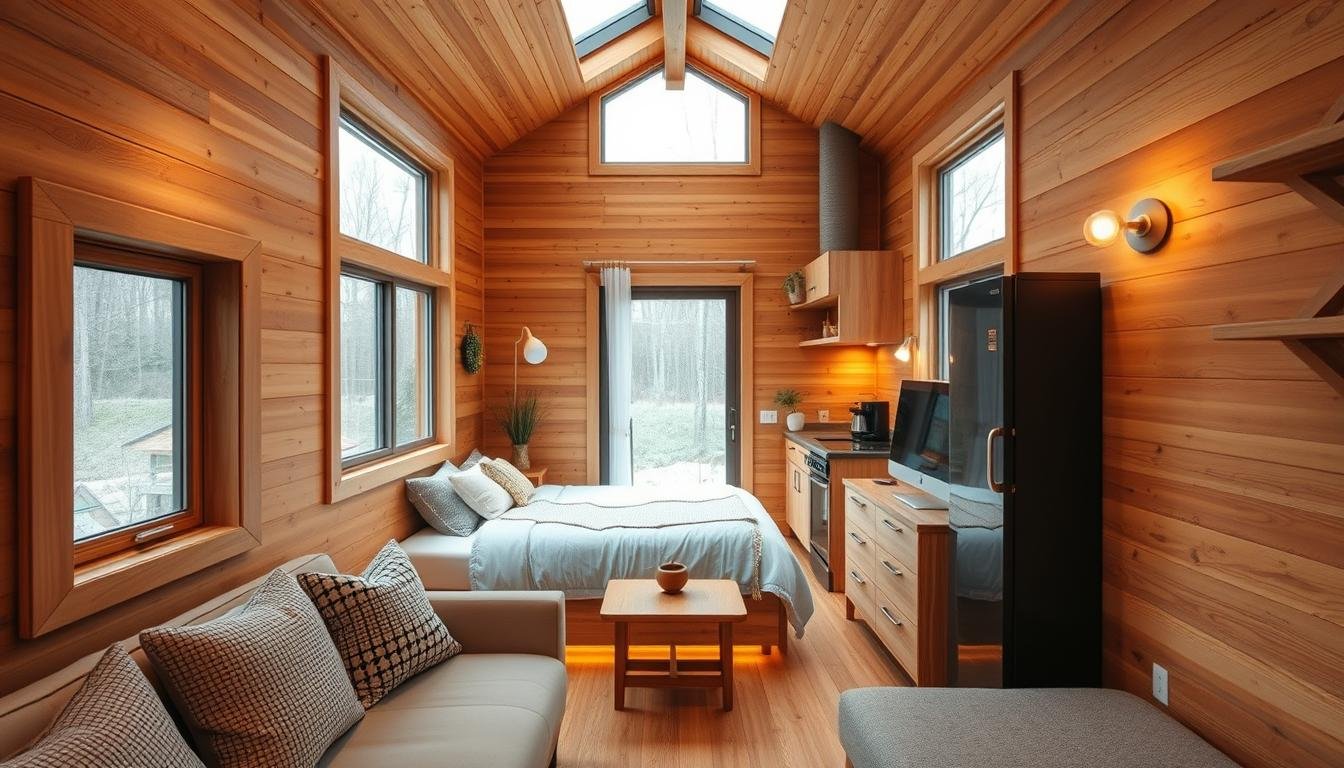
Tiny homes can use 40–75% less energy than conventional houses, cutting utility bills by roughly $2,000–$3,000 a year. This dramatic reduction shows how compact form and smart systems change the scale of energy use.
A compact plan, tight envelope, and right-sized systems make near net-zero operation possible. High-performance elements like triple-pane windows, mineral wool walls (R‑14), continuous exterior insulation, and closed-cell foam in the ceiling (≈R‑48) limit heat loss.
Paired with mini-split heat pumps (SEER ≥15, HSPF 8–10) and ERVs that recover 70–90% of exhaust energy, a well-thought design minimizes conditioning loads. The section previews passive solar siting, clustered plumbing, and storage strategies that save both space and energy.

For readers ready to plan, the article links to a full guide on practical steps and systems selection at Energy-Efficient Tiny House Layout Guide.
Key Takeaways
- Smaller volume means lower heating and cooling demand.
- Use high-R insulation, triple-pane windows, and continuous exterior foam.
- Choose efficient mini-splits and ERVs to recover most exhaust energy.
- Orient for passive solar gain and cluster wet areas to cut losses.
- Combine rooftop solar and battery storage for resilience.
Energy-Efficient Tiny House Layout Overview And Search Intent
A coordinated approach—covering orientation, envelope, and systems—turns a small footprint into a low-demand living space.
Searchers want a clear, practical plan that walks from concept to construction. They seek steps that reduce energy use, cut bills, and keep comfort high in a compact home.
The path starts with high-grade insulation, right-sized HVAC, and renewables. Combined, these measures shrink conditioned volume and lower peak loads.
Readers should expect actionable guidance on cost estimates, incentives, and certifications like ENERGY STAR and Passive House adapted to a small footprint. The article explains measurable outcomes such as lower utility costs and improved indoor air quality.
- Who benefits: DIY builders, downsizers, and off-grid hopefuls with clear design priorities.
- What to expect: Steps on site analysis, floor plan optimization, envelope details, systems selection, and finishes.
- Daily gains: Lower bills, better comfort, and a smaller environmental footprint.
For sample plans and designs that align with these priorities, see a curated collection of small-footprint plans at compact home plans.
Preliminary Planning: Occupants, Climate, Mobility, And Utilities
Early choices about who will live in the home and how they use each room shape every technical and spatial decision that follows.
Defining Occupancy, Pets, And Daily Living Needs
Document the number of occupants, pets, cooking habits, and work-from-home needs. Note storage and activity zones to size each area and avoid overbuilding.
Assessing Climate Zones, Highway Rules, And Transport Frequency
Match envelope targets to climate. Sub-arctic sites need higher R-values and tighter air sealing. For a tiny house on wheels, respect width and height caps (commonly 8.5 ft; permits may allow 10.5 ft).
Choosing Utility Strategies: Grid, Off-Grid, Or Hybrid
Compare water choices (cistern vs. city hookup) and place tanks to protect plumbing chases. Check electrical access—temporary 15A service limits appliance selection. Pick ventilation and toilet options (septic, sewer, or composting) to fit site limits.
- Create scale cutouts of fixtures and furniture to test the plan before building.
- Roll these inputs into a systems decision that balances mobility, resilience, and daily needs.
For a practical site checklist, consult a site-prep checklist, and for construction sequencing see the step-by-step build guide.
Site Analysis And Orientation For Passive Solar Gains
Good orientation turns a small footprint into a bright, temperate living area with lower energy needs. A quick site survey maps sun angles, prevailing winds, and slopes to guide window placement, shading, and trailer access.
Sun Path, Wind, And Shading For Natural Light And Heat
Map the sun path to place primary glazing for winter gains while protecting against summer heat with overhangs, exterior shades, or deciduous trees.
Align main glazing to the south in cold climates, then size and shade windows to control glare and overheating.
Use wind roses to site operable windows for cross-breezes. Place them to ventilate without creating cold drafts.
Topography, Access, And Trailer Placement
Select a level area with clearance for the trailer, stabilizers, and safe egress. Check turning radii for delivery and service access.
Topography affects drainage, cistern siting, and PV tilt if rooftop solar is planned. Include clear paths to maintenance zones and future decks or storage.
Shield the undercarriage from wind to reduce conductive and convective losses and protect plumbing chases on exposed sites.
- Practical tip: Orient the long axis to capture low winter sun and use shading devices for summer comfort.
- Plan access: Leave room for service vehicles and safe removal of stabilizers.
Compact Floor Plan Strategy To Maximize Small Spaces
Smart zoning turns every square foot into usable room by separating active day areas from quiet night zones. This approach keeps privacy and acoustic comfort while making the most of limited size.

Zoning With Multi-Functional Furniture
Lofts or elevated sleep platforms keep sleeping areas tucked away from the main living space. Movable ladders and convertible sofas make daytime use flexible.
Circulation And Plumbing Efficiency
A single circulation spine reduces wasted hallways and increases usable floor area. Placing the kitchen and bath back-to-back shortens plumbing runs and cuts heat losses.
Built-In Storage And Door Choices
Stairs-as-storage, recessed niches, and sofas with concealed storage add capacity without bulk. Pocket and barn doors save swing clearance and free walls for shelving.
“Design that respects scale gives occupants more useful space than a larger plan with poor organization.”
| Strategy | Benefit | Typical Impact |
|---|---|---|
| Single Spine Circulation | Less hallway waste | +10–20% usable area |
| Back-to-Back Wet Rooms | Shorter plumbing runs | Lower installation cost |
| Stairs-As-Storage | Hidden storage | Clearer pathways |
Right-sizing fixtures and appliances to match daily use improves ergonomics and reduces unnecessary bulk. These choices help a small house feel roomy and efficient.
Building Envelope Priorities: Insulation, Air Sealing, And Thermal Bridging
Controlling conductive and convective heat paths starts with the right assemblies and verified air sealing. A strong envelope raises comfort, lowers loads, and lets systems be smaller.
Target R-Values For Walls, Roof, And Floor In U.S. Climate Zones
Walls: Aim for assemblies near R-27.5 using R-14 mineral wool, R-5 exterior graphite polystyrene, and an R-6.5 interior services shield.
Ceiling/Roof: Prioritize ~R-48 with 8″ closed-cell foam or SIPs to simplify thermal continuity since heat rises.
Floor: Use continuous 7.5″ EPS (~R-37.5) below and between joists for trailers or exposed underfloors.
Air Sealing Tactics And Blower Door Verification
Seal sheathing seams, window and door interfaces, and mechanical penetrations with caulk and spray foam. A blower door test locates leaks and verifies results.
Address service chases and roof-to-wall junctions early; these are common failure points on mobile and small building types.
Reducing Thermal Bridging With Continuous Exterior Insulation
Continuous exterior insulation cuts conductive losses through studs. Combine it with advanced framing to lower thermal bridges.
Material choices should balance weight, fire resistance, and moisture control for a safe, durable small house.
| Assembly | Typical R-Value | Primary Benefit |
|---|---|---|
| Wall: Mineral Wool + XPS + Interior Shield | R‑27.5 | Thermal continuity, service chase protection |
| Ceiling: 8″ Closed-Cell Foam / SIP | R‑48 | High top-end R, airtightness |
| Floor: Continuous EPS Below Joists | R‑37.5 | Protects underside, reduces cold floors |
- Exceed code: Higher R targets improve comfort and shrink equipment needs.
- Verify: Use blower door results to guide remedial sealing.
- Choose materials: Prefer products that meet weight, moisture, and fire goals for mobile and fixed foundations.
High-Performance Windows And Natural Light
Choose glazing that matches climate and use: low-E coatings, gas fill, and double or triple panes change comfort and stray heat gains.
Selecting Low-E, Double Or Triple Glazing And Proper RO Sizing
Triple-pane units raise thermal performance over double glazing and cut conductive losses next to living spaces.
Order windows by rough opening (RO) and confirm dimensions before framing. For mobile house builds, shim only at the bottom to avoid lateral stress on the glass.
Window Placement For Passive Solar And Overheating Control
Place primary glazing to harvest winter sun and reduce east/west glass that causes midday glare and excess heat in summer.
Use selective low-E coatings and exterior shading to tune solar heat gain by climate.
- Compare double vs. triple glazing with argon/krypton fills to lower U-factor.
- Verify RO measurements and follow mobile-install steps: flash bottom first, then sides and top; leave bottom untaped to drain.
- Seal trims with silicone and finish with a water-resistant membrane to stop intrusion while keeping weep paths open.
- Place operable windows for cross-ventilation without cutting structural studs.
- Balance window-to-wall ratios to admit natural light but preserve insulation continuity in a small house.
Heating, Cooling, And Ventilation Systems That Fit Tiny Homes
Systems Sized For Small Volumes Keep Comfort Stable and Cut Waste. Right-sized equipment runs longer at low power and avoids short cycling that raises energy consumption and noise.
Mini-Split Heat Pumps: SEER And HSPF Targets
Ductless mini-splits with variable-speed compressors suit compact spaces. Aim for SEER ≥15 and HSPF 8–10 to get reliable heating and cooling while lowering energy use.
Install multiple indoor heads or a single well-placed unit to avoid cold spots. Quiet operation and inverter controls provide steady comfort without oversized capacity.
ERV For Balanced Fresh Air, Humidity, And Energy Recovery
ERVs balance supply and exhaust air, stabilize indoor pressure, and recover 70–90% of outgoing heat. They cut moisture loads in warm months and reduce heating demand in cold months.
Use accessible filters and a simple maintenance schedule to protect indoor air quality and system performance.
Supplemental Options: Radiant Floors And Ceiling Fans
Radiant floor zones work well in bathrooms and entries to provide low-temperature comfort and complement the primary system.
Ceiling fans improve perceived cooling and destratify warm air at very low wattage. Place fans to avoid direct drafts and keep noise minimal.
For manufacturer sizing tips and product choices, see compact HVAC recommendations.
Renewable Power Options: Solar Panels And Small Wind
Sizing a rooftop PV array and matching battery storage starts with a realistic daily kWh budget. Document appliance draws, lighting, and peak loads to convert daily use into a target solar yield. This step drives panel count and battery capacity so systems perform as expected.

Rooftop vs. Ground Arrays. Rooftop panels save ground space and simplify wiring, but shading, tilt, and trailer mobility can limit yield. Ground-mounted arrays allow optimal tilt and easier maintenance for mobile or off-grid setups.
Battery Choices And Sizing. Compare lithium iron phosphate (LiFePO4), lead‑acid, and sealed AGM for cycle life, weight, and space needs. Right-size storage to provide critical autonomy days, considering inverter losses and depth‑of‑discharge limits.
Practical Design Notes
- Calculate daily kWh from measured loads to size panels and storage accurately.
- Use an energy monitor to validate assumptions and tweak array size after occupancy.
- Consider a modest wind turbine as a supplemental option where average wind speeds justify it.
- Follow code for wiring, and match inverter/charger specs to battery chemistry for safe integration.
| Battery Type | Cycle Life | Suitability For Small Homes |
|---|---|---|
| LiFePO4 | 2,000–5,000 cycles | High, lighter, long life |
| AGM | 300–700 cycles | Moderate, cheaper, heavier |
| Flooded Lead | 500–1,200 cycles | Lower cost, needs maintenance |
Final tip: Combine a realistic load budget, a measured energy monitor, and conservative panel sizing to build a resilient power system that fits site constraints and daily life.
Water Conservation, Rain Harvesting, And Greywater Reuse
Conserving water at the fixture and capturing rain from the roof together lower running costs and simplify systems.
Low-Flow Fixtures And Efficient Plumbing
Low-flow showerheads (
Point-of-use tankless or small electric heaters reduce wait times and decrease heat loss in short runs.
Manifold distribution and compact plumbing runs shorten waits for hot water and save energy used to heat it.
Rainwater Cisterns, Filtration, And Pumping
Rain collection needs gutters, a first-flush diverter, a storage cistern, sediment and carbon filters, and optional UV treatment.
Pump sizing and pressure regulation deliver steady flow for fixtures and appliances while protecting components from dry-run damage.
Greywater Routing And Biodegradable Soaps
Where allowed, greywater can irrigate subsurface beds or landscaped areas. Use biodegradable soaps and maintain simple filters on a schedule.
Lifecycle benefits: lower monthly bills and smaller hot-water loads add up to reduced long-term cost.
| Component | Typical Spec | Benefit |
|---|---|---|
| Showerhead | <2.5 gpm | Lower daily water use |
| Faucet Aerator | ≈1.5 gpm | Reduced flow, maintained pressure |
| Rain Cistern | 100–500 gal (site dependent) | Supplementary supply, lowers demand |
| Pump & Regulator | Match peak fixture flow, include pressure tank | Stable delivery, protects pump |
Off-Grid Systems Planning And House Plan Selection
An off-grid project succeeds when systems for power, water, and waste are planned alongside the floor plan from day one.

Passive Solar, Earthship, Straw Bale, Cob, And Tiny House Options
Off-grid typologies vary by how they store and move heat. Passive solar and earthship designs favor thermal mass to stabilize indoor swings.
Straw bale and cob emphasize high insulation and breathable assemblies. A tiny house option focuses on reduced volume and simplified systems.
Energy, Water, And Waste System Integration In Plans
Design steps follow a clear path: site analysis, concept, floor plan, materials selection, then sizing of PV, batteries, rainwater capture, and waste options.
Install PV and batteries and route rainwater or well connections at the design stage to avoid costly retrofits later.
| Typology | Thermal Strategy | Best Suited For |
|---|---|---|
| Passive Solar | Glazing + thermal mass | Sunny sites, moderate budgets |
| Earthship | Heavy mass (tire walls) | Desert/temperate sites, long-term stability |
| Straw Bale / Cob | High insulation, breathable | Wet or cold climates, low-embodied energy goals |
| Tiny House | High envelope performance, low volume | Mobile or tight-budget projects |
Practical advice: Align plan selection with solar access, local climate, household size, and available water. Consider professional plans with validated details and material takeoffs to streamline construction.
For curated off-grid designs and vetted drawings, review a collection of off-grid house plan options at off-grid house plans.
Materials And Methods For Efficiency And Durability
Durable, lightweight systems reduce trailer loads while improving thermal continuity and air sealing.
SIPs, Mineral Wool, Closed-Cell Foam, And Recycled Content
SIPs speed up construction and cut thermal bridging compared with stick-built walls. They arrive prefabricated and seal tight when installed correctly.
Mineral wool, EPS, and closed-cell foam each offer different R-value per inch, moisture behavior, and weight. Closed-cell foam adds structure and a vapor barrier. Mineral wool resists moisture and holds sound. EPS is light and cost-effective.
Recycled content in insulation and finishes lowers embodied carbon and adds character when reclaimed wood is used for trims and cabinets. For reclaimed wall options, see this guide to upcycled materials.
Lightweight, Weather-Resistant Siding And Roofing Choices
Choose cladding like cedar channel boards or corrugated galvanized metal to keep the overall building weight down and resist weathering.
Metal roofing over furring strips improves airflow under panels. That approach reduces heat transfer and cuts noise from rain.
| Component | Benefit | Note |
|---|---|---|
| SIPs vs Stick-Built | Faster install, better air seal | Prefab panels for walls reduce on-site labor |
| Insulation Types | Varying R/in, moisture handling | Closed-cell (rigid), mineral wool (moisture tolerant), EPS (light) |
| Cladding | Lightweight, durable | Cedar or corrugated metal limits trailer load |
| Fasteners | Long-term corrosion resistance | Use galvanized or stainless hardware |
Structural Choices: Trailer, Floor, Walls, And Roof Loads
A well-specified foundation frame simplifies insulation, lowers profile, and supports larger overhangs safely. The trailer is the true foundation; picking axles rated above the total weight prevents overload during transport and service.

Trailer Ratings, Overhangs, And Anchoring
Select dual 7,200 lb axles or higher for most builds. Consider low-rider frames, square wheel wells, and avoiding a wood deck to improve insulation clearance and headroom.
When floors extend beyond 8.5 ft, reinforce with added joists and tie to the steel frame. Use grade 8 bolts and self-tapping screws at splice points for transport-grade anchoring.
Stud Spacing, Headers, Rafters, And Snow Load Considerations
Match stud spacing to insulation modules: 16″ or 24″ on center simplifies installation and reduces thermal bridging.
Size headers to the opening span and loads above; a properly sized header keeps walls straight and safe in small houses.
Rafters such as 2x10s spaced per span tables and tied with hurricane ties resist uplift. Increase member size where regional snow loads demand it.
- Select Trailer Capacity: Choose axles and frame features that ease construction and maximize interior headroom.
- Anchor Methods: Bolt floor joists to steel beams, use through-bolts, and add welds or brackets where applicable.
- Stud Strategy: Align framing with insulation widths to save time and thermal performance.
- Header Guidance: Size headers by door/window span; keep consistent bearing points.
- Rafter Notes: Use span tables, hurricane ties, and factor snow loads into rafter selection.
- Quality Control: Square walls, level the trailer, and use temporary bracing during construction.
| Component | Common Spec | Why It Matters |
|---|---|---|
| Axles | Dual 7,200 lb+ | Prevents overload, improves safety |
| Stud Spacing | 16″ or 24″ O.C. | Matches insulation, reduces bridging |
| Headers | Sized to span | Maintains wall strength |
| Rafters | 2×10 typical; hurricane ties | Handles roof and snow loads |
Electrical Planning: Loads, Circuits, And Appliance Selection
Careful electrical planning turns limited supply into reliable everyday power for appliances and lighting. Start by listing every device and its rated wattage. That list becomes the load schedule for panel selection and breaker sizing.
Panel, Wire Gauges, And Load Budgeting With Energy Monitors
Use a simple load worksheet to match appliance draws to available electricity. Treat a 15A 120V extension feed as roughly 1,500W usable rather than the 1,800W theoretical to keep a safety margin.
Wire and breaker guidance: 14 AWG for lighting circuits (15A) and 12 AWG for general outlets (20A). Even when inspections are optional, follow code practice to avoid hazards.
Monitor real draws with a Kill A Watt or similar to refine the schedule and prevent overloads.
LED Lighting Design And Color Temperature For Comfort
Plan layered lighting: ambient, task, and accent. Use warm LEDs (2700–3000K) at low wattage; 5W bulbs replace higher-draw lamps and improve comfort.
Prioritize ENERGY STAR appliances and right-sized units to cut baseline consumption. Use sub-circuits for the kitchen and dedicate breakers for high-demand appliances to protect the system.
| Circuit Type | Wire Gauge | Breaker | Typical Use |
|---|---|---|---|
| Lighting | 14 AWG | 15A | LED fixtures, 5W bulbs |
| General Outlets | 12 AWG | 20A | Small appliances, chargers |
| Dedicated High Load | Size Per Appliance | As Required | Fridge, induction cooktop, washer |
- Create a load schedule and match appliance wattage to circuit capacity.
- Use monitoring to optimize behavior and delay costly upgrades.
Storage, Lofts, And Interior Finishes To Save Space And Energy
Using lofts and integrated storage reclaims floor area and keeps day-use space open for living activities. Small lofts — for example, an 8.5 ft run for a sleeping nook or a 5 ft shelf-style loft for gear — add function without expanding the footprint.

Stairs-As-Storage And Wheel-Well Solutions
Build stairs over wheel wells to double as drawers and cabinets. Use plywood cores with a veneer face for strength and low weight.
They keep circulation clear while turning otherwise wasted volumes into organized storage. Hardware like soft-close slides makes the details feel refined.
Floating Shelves, Recessed Niches, And Finishes
Floating shelves on keyhole brackets hold books and gear without bulky supports. Recessed niches work in interior walls where they avoid insulation chases and preserve thermal continuity.
- Lofts add sleeping or storage zones and preserve main floor use.
- Stairs-as-storage capitalize on wheel-well volume and keep paths open.
- Floating shelves and recessed niches maximize wall utility with minimal impact.
- Choose lightweight panels, T&G boards, or reinforced drywall for durable finishes.
- Integrate low-voltage lighting beneath shelves and stairs to boost task light and perceived space.
| Element | Benefit | Note |
|---|---|---|
| Loft (8.5 ft) | Extra sleeping/storage | Preserves floor area |
| Stairs-As-Storage | Hidden capacity | Use plywood + veneer |
| Recessed Niche | Wall utility | Avoids insulation conflicts |
“Well-placed storage makes a small plan feel spacious and ordered.”
Energy Standards, Certifications, And Incentives
Certifications and incentives turn good design into measurable savings and market value.
ENERGY STAR, LEED, And Passive House Considerations
ENERGY STAR homes typically exceed the 2009 IECC by at least 10% and often deliver 20–30% greater efficiency. This gives buyers a clear performance signal.
LEED rates projects across energy, water, indoor air quality, and materials. It helps owners document broader sustainability and resale value.
Passive House emphasizes airtightness, superinsulation, and high-performance windows. These tactics scale well to smaller footprints and lower ongoing energy needs.
Tax Credits And Rebates For Solar And Efficiency Upgrades
Federal solar tax credits can cover up to 30% of installed cost. Many states and utilities add rebates that reduce upfront cost further and help owners save money sooner.
Paperwork often requires test results like blower door scores and equipment ratings. Document R-values, appliance specs, and invoices to speed rebate approval.
Note: Verified efficiency reduces operational energy and cuts carbon emissions over the building’s life.
| Program | Primary Benefit | Typical Requirement |
|---|---|---|
| ENERGY STAR | Verified performance, resale confidence | Third-party inspection, energy targets |
| LEED | Holistic sustainability scoring | Documentation on energy, water, IAQ, materials |
| Passive House | Lowest operational loads | Blower door and strict component specs |
| Federal/State Incentives | Lower upfront cost, save money | Invoices, equipment ratings, permit copies |
Energy-Efficient Tiny House Layout: Step-By-Step How-To Summary
Start with a clear plan that ties occupant needs to site conditions. This way the build avoids late changes and keeps costs down.
From Concept And Site To Envelope, Systems, And Finishes
Assess occupants, climate, and mobility first. Note daily routines, storage needs, and transport limits to shape a practical plan.
Analyze sun and wind to place glazing and shading for passive gains and glare control the right way.
- Draft a compact floor plan that clusters plumbing and frees circulation.
- Build a high-R envelope with continuous insulation and verify airtightness.
- Select high-performance windows and balance passive heat with shading.
- Choose mini-split heating and an ERV sized for the small volume.
- Size PV and battery storage from measured or estimated daily use.
- Design water capture and greywater routing; pick durable, low-weight materials.
- Confirm structure, wire to correct gauges, and integrate lofts and built-in storage.
| Phase | Key Action | Why It Matters |
|---|---|---|
| Concept | Define needs and plan | Prevents rework |
| Envelope | Continuous insulation + blower door | Reduces load |
| Systems | Mini-split + ERV + PV | Efficient year-round use |
“A simple sequence from needs to finish saves time and yields a resilient, comfortable result.”
Finish with storage strategies, documentation, and incentives to close permits and secure rebates.
Conclusion
A well-documented path from site to systems helps owners cut utility bills and avoid costly rework. It ties occupant needs to orientation, envelope, and right-sized HVAC so the result is predictable and comfortable.
Apply the step-by-step plan—from siting and high-performance walls to selective glazing and balanced ventilation—to reduce loads and save money over time.
Use incentives and certifications to accelerate payback and verify results. See an example build and explore practical budget strategies to adapt proven details for your project.
Thoughtful choices make small homes livable, resilient, and economical for years to come.
FAQ
What size and floor plan work best to maximize space and save on heating and electricity?
The ideal footprint keeps living areas compact and zones day and night. A 200–400 sq ft plan with open sightlines and multi-functional furniture—fold-down tables, sofa-beds, and stairs-as-storage—reduces wasted area and lowers conditioned volume. Compact circuits and LED lighting cut electrical loads; designing for passive solar gains and proper insulation lowers heating needs and ongoing bills.
How should occupants and climate influence preliminary planning?
Occupancy, pets, and daily routines determine storage, bathroom, and appliance sizing. Climate directs target R-values for walls, roof, and floor and choice of heating or cooling systems. In cold zones prioritize higher insulation and airtightness; in hot, emphasize shading, ventilation, and reflective roofing to reduce cooling loads.
How does site orientation improve passive solar performance?
Orient the long axis toward the sun path to capture winter solar heat and provide shading in summer. Use overhangs, deciduous planting, and operable shading to control overheating. Wind analysis helps place ventilation openings and trailers to exploit breezes for cooling and fresh air.
What insulation and air-sealing targets are recommended?
Aim for R-values appropriate to the U.S. climate zone: high R in cold regions for walls, roof, and floor. Use continuous exterior insulation to reduce thermal bridging. Prioritize air sealing at joints, penetrations, and around windows; verify with a blower door test and address leaks to cut heating and cooling loss.
Which window types and placements give the best balance of light and heat control?
Choose low-E, double or triple glazing sized to the rough opening and orientation. Place larger windows on south-facing walls for winter gains, and smaller, well-shaded openings on west exposures to limit afternoon overheating. Use shading, operable vents, and exterior blinds to manage light and comfort.
What heating, cooling, and ventilation systems suit small dwellings?
Mini-split heat pumps with high SEER and HSPF ratings offer efficient heating and cooling in compact spaces. An ERV provides balanced fresh air and energy recovery while controlling humidity. Supplemental options include radiant floor heating for even warmth and ceiling fans to improve perceived comfort.
How should solar PV and battery storage be sized for reduced grid dependence?
Size photovoltaics to match annual electrical consumption, accounting for appliances, lighting, and hot water. Pair PV with batteries sized for night use and backup needs; consider peak demand, inverter efficiency, and local solar insolation. Hybrid systems with a generator or grid tie add resilience.
What water-saving strategies and rainwater systems are practical?
Install low-flow faucets, showerheads, and efficient toilets to reduce demand. Use rainwater cisterns with filtration for non-potable uses and design plumbing for minimal runs to conserve hot water. Greywater routing and biodegradable soaps permit landscape reuse where regulations allow.
Which building materials offer durability, insulation, and low embodied carbon?
SIPs, mineral wool, and closed-cell foam provide strong thermal performance; recycled-content sheathing and low-VOC finishes reduce carbon and indoor pollution. Lightweight, weather-resistant siding and metal roofing offer longevity with minimal maintenance.
What structural considerations matter for trailer-based designs?
Match trailer ratings to finished weight and include appropriate anchoring and overhang limits. Design for load distribution, stud spacing, and header sizes that meet snow and wind load requirements. Verify towability and local transport regulations before finalizing the plan.
How should electrical loads and appliance selection be planned?
Create a load budget listing major appliances, HVAC, and lighting. Size the panel and wire gauges for peak loads and future upgrades. Choose ENERGY STAR refrigeration, induction cooktops, and efficient water heaters to minimize consumption; integrate energy monitors for real-time feedback.
What storage and interior finish strategies save space and energy?
Use lofts for sleeping or storage, recessed niches, floating shelves, and built-in cabinets to reduce clutter. Light-colored finishes increase perceived space and improve natural light distribution. Insulated, airtight cabinetry near heat sources can protect stored items and reduce drafts.
Are there incentives or certifications that help offset costs?
Federal tax credits and state rebates often support solar PV and efficient heat pumps; local programs may fund insulation upgrades. Consider ENERGY STAR appliances, LEED or Passive House principles for performance targets, and check utility incentives for storage and demand-response programs.
How do off-grid and hybrid systems change planning and costs?
Off-grid designs raise up-front costs for larger PV arrays, batteries, and backup generation but lower utility bills and footprint over time. Hybrid systems reduce battery size and allow grid support during shortfalls. Careful load reduction and efficient appliances keep system size—and cost—manageable.
What ventilation and moisture-control tactics prevent indoor air issues?
Install an ERV or HRV sized to the living volume and use spot ventilation in kitchens and baths. Proper insulation and vapor control strategies prevent condensation. Monitor humidity and address sources of moisture, including drying racks and indoor plants, to maintain healthy air.
How can one balance lightweight construction with durability and thermal performance?
Combine structural systems like SIPs or advanced framing with continuous exterior insulation and durable cladding. Select corrosion-resistant fasteners and breathable membranes to handle moisture. This balance reduces weight for trailer systems while preserving comfort and lifespan.